Cup “O” Joe the Existentialist sent me something to read the other day that stimulated a flurry of mental, emotional, and spiritual activity; this bLOG flows out of that storm. The word that jumped out and screamed in my face as I read was:
“Barbarian!”
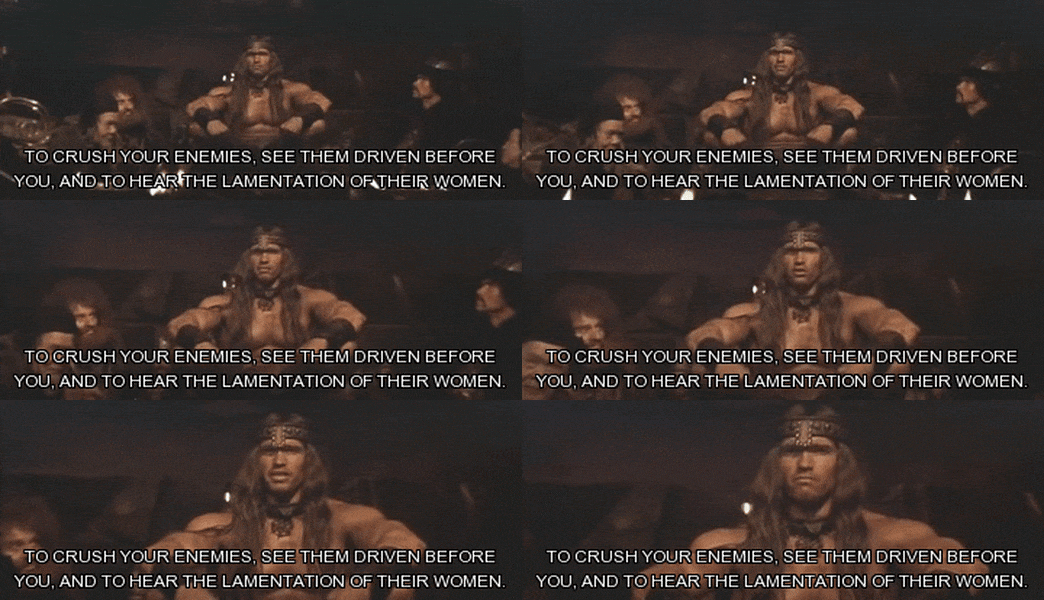
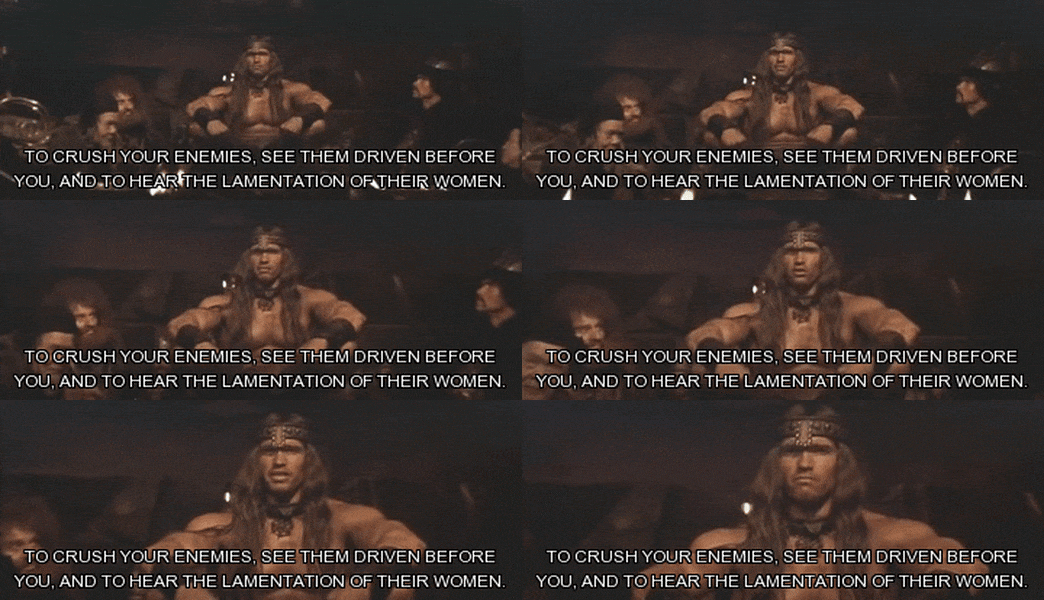
I am a child of the eighties, so Conan the Barbarian, starring Arnold, leaps out in my memories. In the movie, Conan the Barbarian is asked, “What is the best in life?” Conan’s answer:
Unfortunately, the word “barbarian” often elicits a stereotype of the brutal warriors who wreaks havoc, terror, and bloodshed as they invade and maraud one’s homeland. So let’s take a little history field trip to explore this word’s meaning and why it elicits such a flow of consciousness from your friend HitchHiker.
The word barbarian comes from the Greek βάρβαρος (barbaros), an adjective describing any foreigner who does not speak Greek and appears to be a “babbler” who “lacks culture” and is “uncivilized.” This word eventually evolved into a noun, and makes an appearance several times in the Bible (Acts 28:2, 4, Romans 1:14, 1 Corinthians 14:11, Colossians 3:11).
Now there are some indications that the word had an even more ancient origin derived from a word in ancient Sanskrit meaning “stammering.” But for our purposes, understand that to the Greeks, foreigners speaking in their native tongues sounded like they were saying “bar bar bar.” Kind of like Charlie Brown’s teacher who, without Charlie’s translation, sounded like “wah wah wah.” (she would be called a “wahwahian”) Sorry, I digress.
Ironically, the Romans were initially considered barbarians by the Greeks, and they adopted the word into their native tongue (Latin) as “barbara.” Julius Caesar referred to the Celtic (Celtoi) people of Britain as “barbara” NOTE: I apologize up front to those of you who bear that name Barbara in our time, but I simply couldn’t help myself!
Enough vocabulary; let’s move to what’s on my heart. Lately, I have heard an uptick of statements, slurs, fears, and anger about the influx of non-English speaking people coming to our shores. People act like it is a crisis, and it may be. But the “crisis” has happened in North America for at least a millennia!
In the 1950s, it was the Spanish-speaking Puerto Ricans. There were also gobs of Asians who came after the wars on their continent that we participated in to combat tyranny, barbarism, and communism. “Bar-bar-bar.”
At the turn of the century, the Italians and Eastern Europeans fled governmental upheaval and poverty. In the mid-19th century, it was Germans and the Irish looking for better lives. I know; I know… The Irish speak English, but it is heavily accented and peppered with Gaelic expressions making it challenging to understand to those who speak the King’s English. “Bar-bar-bar.”
Dare I mention the unspeakable; the boatloads of Africans trafficked as part of the triangle trade? They didn’t speak the tongue of their oppressors either. “Bar-bar-bar.”
Let’s go deeper, lest we forget. The English and the Spaniards who came to “settle”North America considered the indigenous peoples “barbarians” because they didn’t speak or dress like Europeans. But I’m sure the new arrivals sounded like they were stammering to the current residents. And I bet the 10th and 11th-century Norseman, and those Knights Templar of Oak Island fame, were hard to understand too! “Bar-bar-bar!”
But even the indigenous people spoke different languages, and the other nations must have been difficult to understand and held peculiar habits. The Zuni people of the southwest are fascinating, as their language was more closely related to Japanese than any other indigenous population in North America. “Bar-bar-bar.”
It occurs to me there are many Barbaras inside our gates; the place is simply teaming with us! Thank God Jesus provided another word for us to focus on to help alleviate our fears and angst about the current influx of people trying to escape poverty, turmoil, violence, and crime to come to the shores of this beautiful land of opportunity. Here it is:
שָׁכֵן (shawkane)
πλησίον (plésion)
“Neighbor“
Jesus answered, “The most important is, ‘Hear, O Israel: The LORD our God, the LORD is one. And you shall love the LORD your God with all your heart and with all your soul and with all your mind and with all your strength.’ The second is this: ‘You shall love your NEIGHBOR as yourself.’ There is no other commandment greater than these.” Mark 22:29-31 (emphasis mine)


 SEARCHING FOR 42